> ## Documentation Index
> Fetch the complete documentation index at: https://scanaislop-update.mintlify.site/llms.txt
> Use this file to discover all available pages before exploring further.
# Scan your code for AI slop
> Understand what scanaislop is, the problem it solves, its six analysis engines, supported languages, and the key properties that make it reliable in CI.
 ## What is scanaislop?
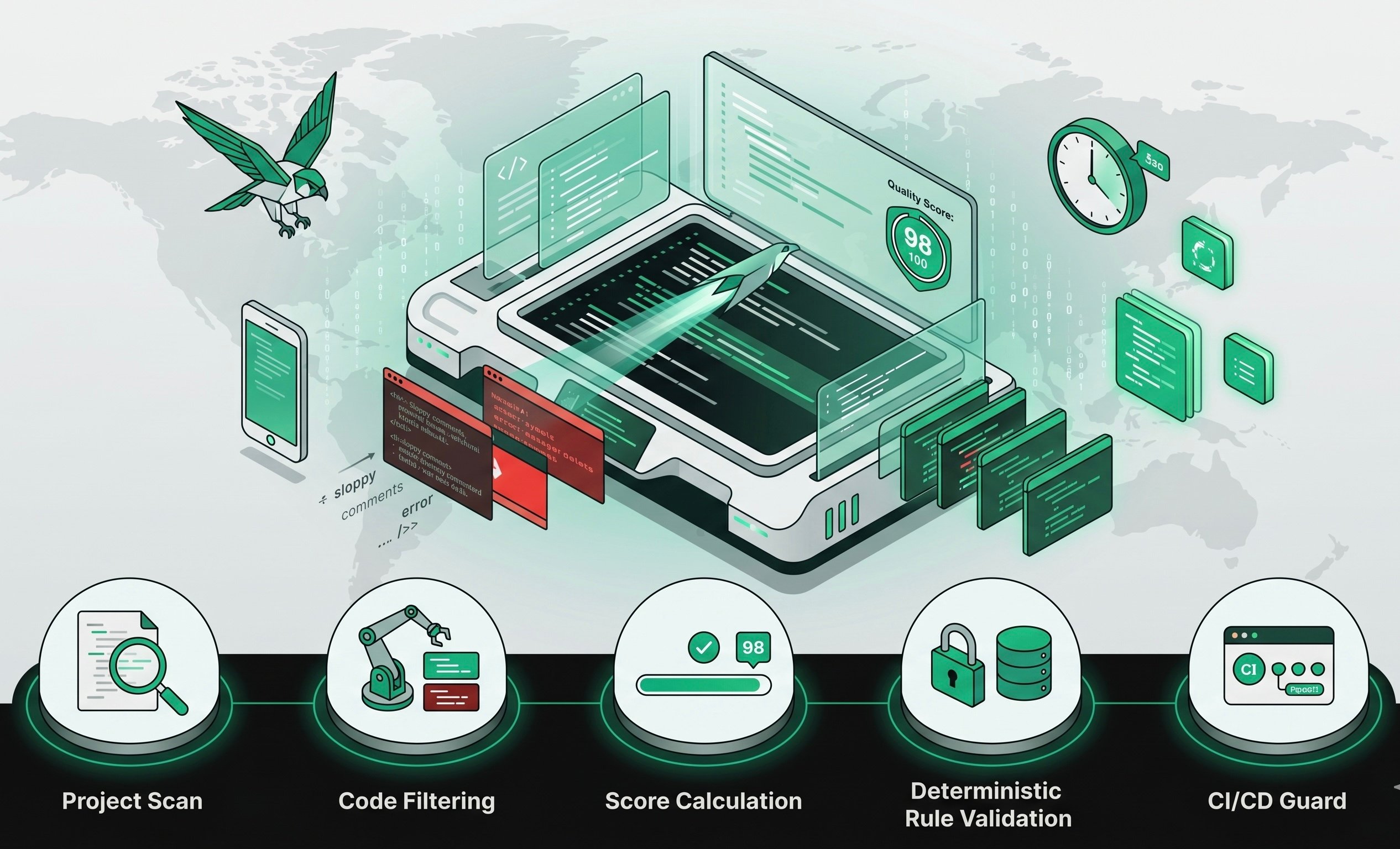
aislop is a quality gate for AI coding agents. It runs six deterministic engines in parallel across eight language targets, reports findings with file and line locations, repairs mechanical issues, and exits with a non-zero code in CI when the score falls below your threshold. There are no LLMs in the runtime path: the score is computed from regex, AST analysis, and standard open-source tooling, so the same code always produces the same result.
## The problem it solves
Every major AI coding agent — Claude Code, Cursor, Codex, OpenCode, Gemini CLI — generates code that satisfies local correctness checks but introduces patterns that degrade long-term maintainability. These patterns are consistent enough across agents and projects to define as rules. aislop encodes more than 50 of them, weighted so high-confidence defects and security findings hit harder than mechanical cleanup. You get one number, one gate, and a clear fix list.
## The six engines
aislop runs six engines on every scan. Each engine targets a different quality dimension and maps to a share of the overall 0–100 score.
Code style consistency checked by **Biome** (TypeScript/JavaScript), **ruff** (Python), **gofmt** (Go), **cargo
fmt** (Rust), **rubocop** (Ruby), and **php-cs-fixer** (PHP).
Language-specific correctness checked by **oxlint** (JS/TS), **ruff** (Python), **golangci-lint** (Go),
**clippy** (Rust), and **expo-doctor** (Expo/React Native).
Complexity and dead code: function and file size limits, deep nesting detection, unused files and dependencies
via **knip**, and AST-based unused-declaration removal.
Patterns specific to AI-generated code: narrative comments, trivial comments, dead patterns, unused imports, `as
any` casts, `console.log` leftovers, TODO stubs, and generic names.
Vulnerabilities and risky code: `eval`, `innerHTML`, SQL and shell injection patterns, and dependency audits via
**npm audit**, **pip-audit**, **cargo audit**, and **govulncheck**.
Structural rules (opt-in): custom import bans, layering rules, and required patterns configured in
`.aislop/config.yml`.
## Supported languages
aislop analyses eight language targets with full engine coverage. Files in other languages are excluded from scoring rather than partially scored — you always know exactly what the number represents.
| Language | Target identifier |
| ------------------- | ----------------- |
| TypeScript | `typescript` |
| JavaScript | `javascript` |
| Expo / React Native | `expo` |
| Python | `python` |
| Go | `go` |
| Rust | `rust` |
| Ruby | `ruby` |
| PHP | `php` |
If a repository is primarily written in an unsupported language (C, C#, Swift, Kotlin, etc.), aislop withholds the
score and reports `scoreable: false` rather than printing a number based on a handful of incidental files.
## Key differentiators
**Deterministic, no LLM at runtime.** aislop uses regex, AST analysis, and standard open-source tooling — never an API call to a language model. The same code in always produces the same score out. This makes the score reliable enough to enforce as a hard CI gate.
**Sub-second.** All six engines run in parallel. For most projects, a full scan completes in well under a second, making it practical as a pre-commit hook and as a post-edit hook inside your coding agent.
**50+ rules, language-specific.** Rules are tuned per language and weighted by severity. Sloppy patterns that indicate deeper problems (swallowed exceptions, unsafe type casts) carry more weight than style findings.
**Zero-config start.** `npx aislop@latest scan` works on any repository without any configuration. Add `.aislop/config.yml` when you want to tune thresholds, override rule severity, or enable the Architecture engine.
**Local repair agent.** `aislop agent` creates an isolated local worktree, runs safe fixes, streams a Codex, Claude Code, or OpenCode repair session, verifies the result, and leaves the diff for review. `aislop fix` remains the deterministic layer for mechanical cleanup.
## Next steps
Scan your first project in under a minute with a single npx command.
Deep dive into the scoring model, engine weights, and rule evaluation order.
Use Codex, Claude Code, or OpenCode while aislop owns scoring and verification.
## What is scanaislop?
aislop is a quality gate for AI coding agents. It runs six deterministic engines in parallel across eight language targets, reports findings with file and line locations, repairs mechanical issues, and exits with a non-zero code in CI when the score falls below your threshold. There are no LLMs in the runtime path: the score is computed from regex, AST analysis, and standard open-source tooling, so the same code always produces the same result.
## The problem it solves
Every major AI coding agent — Claude Code, Cursor, Codex, OpenCode, Gemini CLI — generates code that satisfies local correctness checks but introduces patterns that degrade long-term maintainability. These patterns are consistent enough across agents and projects to define as rules. aislop encodes more than 50 of them, weighted so high-confidence defects and security findings hit harder than mechanical cleanup. You get one number, one gate, and a clear fix list.
## The six engines
aislop runs six engines on every scan. Each engine targets a different quality dimension and maps to a share of the overall 0–100 score.
Code style consistency checked by **Biome** (TypeScript/JavaScript), **ruff** (Python), **gofmt** (Go), **cargo
fmt** (Rust), **rubocop** (Ruby), and **php-cs-fixer** (PHP).
Language-specific correctness checked by **oxlint** (JS/TS), **ruff** (Python), **golangci-lint** (Go),
**clippy** (Rust), and **expo-doctor** (Expo/React Native).
Complexity and dead code: function and file size limits, deep nesting detection, unused files and dependencies
via **knip**, and AST-based unused-declaration removal.
Patterns specific to AI-generated code: narrative comments, trivial comments, dead patterns, unused imports, `as
any` casts, `console.log` leftovers, TODO stubs, and generic names.
Vulnerabilities and risky code: `eval`, `innerHTML`, SQL and shell injection patterns, and dependency audits via
**npm audit**, **pip-audit**, **cargo audit**, and **govulncheck**.
Structural rules (opt-in): custom import bans, layering rules, and required patterns configured in
`.aislop/config.yml`.
## Supported languages
aislop analyses eight language targets with full engine coverage. Files in other languages are excluded from scoring rather than partially scored — you always know exactly what the number represents.
| Language | Target identifier |
| ------------------- | ----------------- |
| TypeScript | `typescript` |
| JavaScript | `javascript` |
| Expo / React Native | `expo` |
| Python | `python` |
| Go | `go` |
| Rust | `rust` |
| Ruby | `ruby` |
| PHP | `php` |
If a repository is primarily written in an unsupported language (C, C#, Swift, Kotlin, etc.), aislop withholds the
score and reports `scoreable: false` rather than printing a number based on a handful of incidental files.
## Key differentiators
**Deterministic, no LLM at runtime.** aislop uses regex, AST analysis, and standard open-source tooling — never an API call to a language model. The same code in always produces the same score out. This makes the score reliable enough to enforce as a hard CI gate.
**Sub-second.** All six engines run in parallel. For most projects, a full scan completes in well under a second, making it practical as a pre-commit hook and as a post-edit hook inside your coding agent.
**50+ rules, language-specific.** Rules are tuned per language and weighted by severity. Sloppy patterns that indicate deeper problems (swallowed exceptions, unsafe type casts) carry more weight than style findings.
**Zero-config start.** `npx aislop@latest scan` works on any repository without any configuration. Add `.aislop/config.yml` when you want to tune thresholds, override rule severity, or enable the Architecture engine.
**Local repair agent.** `aislop agent` creates an isolated local worktree, runs safe fixes, streams a Codex, Claude Code, or OpenCode repair session, verifies the result, and leaves the diff for review. `aislop fix` remains the deterministic layer for mechanical cleanup.
## Next steps
Scan your first project in under a minute with a single npx command.
Deep dive into the scoring model, engine weights, and rule evaluation order.
Use Codex, Claude Code, or OpenCode while aislop owns scoring and verification.